For professionals and families whose finances are becoming too important and too interconnected to manage one decision at a time.
When Your Financial Life Outgrows DIY.
Higher income and growing assets create more opportunity. They also create more interconnected decisions around taxes, investments, family, protection and financial independence.
Noble Oak Capital Partners helps successful professionals turn increasing complexity into a coordinated plan with clear priorities and follow-through.


Cash Flow

Taxes

Investments

Equity
Compensation

Protection

Financial Independence

There Is a Point Where More Money Creates More Decisions, Not More Clarity.
Early in your financial life, the formula can be fairly straightforward: earn more, save consistently, invest intelligently, and avoid unnecessary debt.
But success eventually creates complexity.
- Multiple retirement accounts
- Taxable investments
- RSUs, stock options or bonuses
- Business or 1099 income
- Real estate
- College-funding decisions
- Higher tax exposure
- Insurance needs
- Estate documents
- Charitable goals
- Aging parents
- Growing family responsibilities
- Questions about when work could become optional
DIY may have worked extremely well to get you here. The question is whether the same system is still enough for what comes next.
The Challenge Is No Longer Finding Another Investment. It Is Deciding How Everything Should Work Together.
A portfolio is only one part of the financial picture. As wealth grows, decisions begin affecting one another.
A bonus decision may affect taxes. A stock-compensation decision may affect concentration and liquidity. A home purchase may affect savings goals. A tax strategy may affect retirement accounts. A college-funding decision may affect financial independence. An estate decision may affect how assets are titled and protected.
The more successful you become, the less useful disconnected financial advice becomes. That is where coordinated planning begins to matter.
High Income Does Not Automatically Create Financial Independence.
You can earn a substantial income and still lack clarity around where you are headed.
The better question is not “Are we doing well financially?” It is “What are we actually building toward?”
- When to retire
- Whether to change careers
- Whether one spouse can stop working
- Whether to start or buy a business
- Whether to take a sabbatical
- Whether to help family
- Whether to purchase another property
- Whether to reduce work hours
- Whether work becomes optional


The goal is not simply accumulating more. It is knowing what your growing wealth can eventually make possible.
Tax Complexity Usually Arrives Before People Expect It.
Higher income often creates more planning decisions around retirement-plan contributions, Roth and backdoor Roth strategies, capital gains, equity compensation, taxable investing, asset location, charitable giving, estimated taxes, business income, real estate, state taxation, and future retirement distributions.
Tax preparation looks backward. Financial planning should also look forward.
Noble Oak helps evaluate how decisions today may affect future years and coordinates with tax professionals when specialized tax advice or preparation is required.

Equity Compensation Can Accelerate Wealth and Complexity at the Same Time.
RSUs, stock options and employer stock can create significant wealth. They can also increase tax exposure, concentration risk, liquidity decisions, timing decisions, and dependence on one employer.
The objective is not automatically to sell. The objective is to understand what role that equity should play within the broader financial plan.
- Holding
- Selling
- Gifting
- Tax timing
- Liquidity needs
- Concentration
- Charitable strategies
- Strategic leverage
- Broader portfolio construction
Growing Families Create Competing Priorities.
Successful families rarely have only one financial objective.
Which priorities deserve attention now, and which can wait?
- Maximize retirement savings
- Fund education
- Purchase or renovate a home
- Build taxable investments
- Protect income
- Save for future flexibility
- Help parents
- Travel
- Give charitably
- Build a business
- Reduce taxes
- Create an estate plan
- Become financially independent

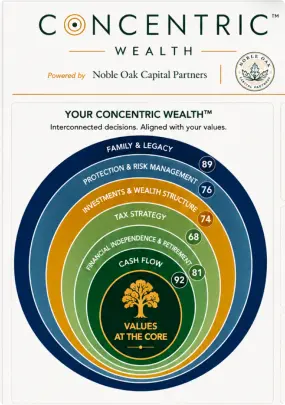
Powered by Concentric Wealth™
Concentric Wealth™ is Noble Oak Capital Partners’ planning system for evaluating the interconnected areas of your financial life.
Rather than beginning with products or investments, we begin with what you want your growing wealth to make possible.
Values at the Core:
What matters most to you and your family?
Cash Flow:
How should today’s income support both today’s lifestyle and tomorrow’s independence?
Financial Independence:
What does “enough” look like, and when could work become optional?
Tax:
How can tax decisions be evaluated across multiple years rather than one return at a time?
Investments:
How should retirement plans, taxable accounts, Roth assets, equity compensation and other investments work together?
Protection:
Has insurance and risk management kept pace with your growing financial life?
Family & Legacy:
How should your resources support education, family, charitable priorities and future generations?
Your Top 3 Acorns™
As complexity grows, the problem is rarely a shortage of ideas. The problem is too many ideas competing for attention.
A comprehensive financial analysis can easily uncover twenty things worth improving. That does not mean you should work on twenty things at once.
Noble Oak identifies your Top 3 Acorns™, the three priorities we believe deserve the greatest attention next.
Clarity is knowing what matters. Completion is making sure it gets done.
- What needs to happen
- Why it matters
- Who owns it
- When it should happen
- How progress will be tracked
An Illustrative Emerging Wealth Example
Consider a fictional couple in their early 40s. Household income has grown significantly over the past several years.
They have strong retirement savings, a taxable brokerage account, RSUs from one employer, two children, a mortgage, growing charitable goals, increasing tax exposure, older estate documents, and a desire to make work optional before traditional retirement age.
Their initial question is: “Are we saving enough?” The broader analysis may reveal better questions around account structure, employer-stock concentration, tax opportunities, protection, estate documents, and what amount of wealth actually makes work optional.
Potential Top 3 Acorns™ might include:
- Create a coordinated savings and investment structure across retirement, Roth and taxable accounts.
- Evaluate tax and liquidity strategies surrounding equity compensation and employer stock.
- Define a financial-independence target and build the savings path required to reach it.

When Has DIY Financial Planning Outgrown Its Usefulness?
There is no single asset level where DIY stops working. The better signal is complexity.
- Your tax decisions affect multiple years
- Equity compensation is meaningful
- Your investments span many account types
- Your income is highly variable
- Business or real-estate interests are involved
- Your estate plan has become more important
- Several large family goals compete for resources
- You spend increasing time researching financial decisions
- You worry about missing opportunities you do not know exist
- You have accumulated meaningful wealth but still lack confidence about what should happen next
Frequently Asked Questions
What should I do after maxing out my retirement plan?
The answer may involve taxable investing, Roth strategies, debt reduction, charitable planning, equity compensation, education funding or other priorities depending on the broader plan.
Should I be doing backdoor Roth contributions?
Potential eligibility and tax consequences depend on individual circumstances, including existing IRA balances and current tax rules. This should be evaluated as part of a broader tax and retirement strategy.
How much should we keep in cash?
The right amount depends on spending needs, job stability, upcoming purchases, investment strategy, business interests and personal comfort.
How should RSUs fit into our investment strategy?
The decision depends on concentration, taxes, liquidity needs, future vesting and the role employer stock already plays in your financial life.
How much do we need before work becomes optional?
That depends on expected spending, taxes, investment resources, future income, healthcare, longevity and the flexibility you want.
When should we hire a financial advisor?
Often when the cost of disconnected decisions, missed opportunities or uncertainty becomes greater than the value of continuing to manage everything independently.
Who We Work With
- Successful professionals and families with approximately $1 million to $3 million or more of investable assets
- Households earning significant W-2, bonus, commission, equity-compensation or business income
- Families with growing tax complexity
- People who want more clarity around financial independence
- Households with accumulated wealth across multiple account types
- Families who need family goals coordinated with long-term investing
- People with financial decisions spread among multiple professionals
- People who want a clearer system for deciding what deserves attention next
Why Noble Oak
Capital Partners?
Jason Noble brings more than 20 years of financial-services experience and holds the CFP®, RICP® and CEPA® credentials.
Values Become the Plan:
Growing wealth should support the life and priorities that matter most.
Every Decision Connected:
Taxes, investments, cash flow, protection, family and financial independence should not be managed in separate silos.
Clarity Through Completion:
The planning process identifies priorities, assigns responsibility and follows through on implementation.
The Next Stage of Wealth Requires a Better System.
You do not need to wait until you have $5 million, $10 million or a traditional retirement date before planning becomes valuable.
If your financial life has become more complex, more interconnected and more consequential, it may be time for a more deliberate system.
No assumption that you need to turn everything over. No one-size-fits-all plan. Just a conversation about where you are, what you are building toward and what may deserve attention next.