

Serving business owners in Charleston, Mount Pleasant, and across the country.
Your Business is Part of Your Financial Plan. Not Separate from It.
You may have spent decades building your company, but as the business grows, so does the number of financial decisions connected to it.
Business value. Taxes. Investments. Estate planning. Risk. Succession. Family. Retirement. An eventual sale.
Noble Oak Capital Partners helps business owners bring those decisions together, understand what matters most, and move the right priorities forward.

A Successful Business Does Not Automatically Create a Successful Exit.
For many owners, the company is their largest asset, their primary source of income, and a major part of their identity.
That creates questions an investment portfolio alone cannot answer:
These are not separate planning questions. They affect one another.
- What does my business need to be worth for me to become financially independent?
- How much of a future sale would I actually keep after taxes and transaction costs?
- Are too many of my assets, income, and risks tied to the same company?
- What happens to my family if something happens to me before an exit?
- Should ownership, estate, charitable, or tax strategies be considered before a buyer appears?
- What would life after the business actually require financially?
Thinking About Selling in the Next 3-5 Years?
The Years Before a Sale May Matter as Much as the Transition Itself. Once a buyer appears or a transaction begins to take shape, some planning opportunities may become more difficult, less effective, or unavailable.
That is why we believe owners should begin asking important questions well before an LOI is signed.
1
Business value:
What is the company worth today, and what could increase its transferable value?
2
Personal financial independence:
What does the business ultimately need to produce for you and your family?
3
Tax planning:
How could the timing and structure of a future transaction affect what you keep?
4
Estate and legacy planning:
Are there strategies worth evaluating before the value of the business becomes established through a transaction?
5
Risk and protection:
What happens if disability, death, litigation, a key employee loss, or another event occurs before the transition?
6
Life after the business:
How will proceeds eventually be invested, distributed, protected, gifted, or used to create income?

The goal is not simply to sell the business. The goal is to make the business serve the life you built it to create.
Every Decision Connected
Business owners often have excellent professionals around them. A CPA handles taxes. An attorney handles legal matters. An insurance professional evaluates protection. An M&A advisor may eventually manage a transaction. An investment advisor manages assets.
The problem is not necessarily the quality of those professionals. The problem is that someone needs to see how the decisions connect.
Noble Oak helps coordinate the financial strategy across your personal wealth, business interests, tax considerations, estate objectives, retirement goals, risk management, and other professionals.
We do not replace your attorney, CPA, valuation professional, or transaction advisor. We help make sure the financial decisions surrounding them are connected to the same plan.
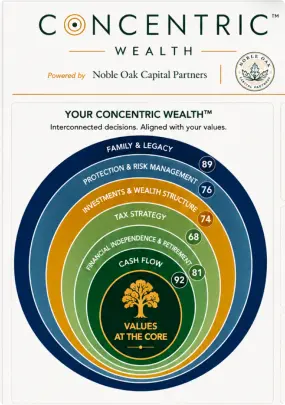
Concentric Wealth™ for Business Owners
Concentric Wealth™ is Noble Oak Capital Partners’ planning system for evaluating the interconnected areas of your financial life.
Rather than beginning with an investment portfolio, we begin with what you want your finances and your business to make possible.
We then evaluate the broader financial picture, identify what deserves attention, and prioritize the actions that can have the greatest impact.
Values at the Core:
What matters most to you, your family, and the life you are building?
Cash Flow:
What does the business provide today, and what changes if that income stops?
Financial Independence:
How much do you need from the business, your investments, and other resources to create choice?
Tax:
Where might today’s decisions affect tomorrow’s tax liability?
Investments:
How should your personal portfolio evolve when a significant portion of your wealth may already be concentrated in the company?
Protection:
What could disrupt the plan before a transition occurs?
Family & Legacy:
Who and what are you ultimately building all of this for?
Six Interconnected Areas. One Financial Life.
Your Top 3 Acorns™
A comprehensive plan can uncover dozens of things worth considering. Trying to address all of them at once usually creates more complexity, not more progress.
Noble Oak identifies your Top 3 Acorns™, the three priorities we believe deserve attention next.
Because a Financial Plan Has Little Value if Nothing Actually Gets Completed.
- A clear action
- A responsible owner
- A target date
- Follow-through
- Remeasurement

Questions Worth Answering Before You Exit
1. What is my business worth today?
Not what you hope it is worth. What would the marketplace reasonably support, and what factors could increase or reduce transferable value?
2. What do I need to net from a sale?
Enterprise value is not the same as personal financial independence. Taxes, debt, transaction costs, deal structure, lifestyle needs, and other assets all matter.
3. Could I afford not to sell?
Knowing your personal financial position creates negotiating leverage. An owner who must accept a transaction is in a very different position from one who can walk away.
4. What should happen before a buyer or LOI appears?
Tax, estate, charitable, ownership, protection, and family-planning decisions may deserve consideration well before a transaction becomes imminent.
5. Is my financial life too concentrated in the company?
The company may simultaneously represent your income, net worth, retirement plan, and family security.
6. What happens the day after closing?
A liquidity event creates a new set of decisions involving investments, income, taxes, gifting, estate planning, family, purpose, and life after ownership.
Who We Work With
- Business owners who have built meaningful personal wealth alongside their company
- Owners with significant net worth concentrated in the business
- Owners who want business and personal financial decisions coordinated
- Owners contemplating a sale, recapitalization, succession, or family transition
- Owners who expect a potential liquidity event within the next several years
- Owners who want greater clarity around personal financial independence
- Owners who have multiple advisors but no one clearly connecting the financial decisions
- Owners who want a plan that moves from analysis to implementation
You do not need to have a buyer today to begin preparing for tomorrow.
Why Noble Oak
Jason Noble brings more than 20 years of financial-services experience and holds the CFP®, RICP®, and CEPA® credentials.
As a Certified Exit Planning Advisor, Jason brings an exit-planning perspective to the broader financial work surrounding business ownership, while Noble Oak coordinates with the client’s existing tax, legal, valuation, insurance, and transaction professionals where appropriate.
Values Become the Plan:
The plan begins with what the money and the business are supposed to make possible.
Every Decision Connected:
Business, tax, investment, estate, protection, retirement, and family decisions should not live in separate silos.
Clarity Through Completion:
The work is prioritized, implemented, monitored, and revisited instead of ending with a financial-plan presentation.
Frequently Asked Questions
When should a business owner begin planning for an exit?
Ideally, planning begins before a transaction is imminent. For an owner considering a transition within approximately three to five years, there may be time to evaluate business value, personal financial independence, tax and estate considerations, risk, succession alternatives, and the advisory team before transaction terms begin limiting flexibility.
Do I need to know when I am selling?
No. Exit planning is not simply preparation for a sale. It can also help an owner understand business value, reduce dependence on the company, evaluate succession alternatives, and determine what would need to be true financially before a transition makes sense.
Does Noble Oak value or sell businesses?
Noble Oak provides financial planning and wealth-management guidance. When business valuation, transaction advisory, legal, or tax work is required, we coordinate with the appropriate qualified professionals.
Will Noble Oak work with my CPA and attorney?
Yes. For many business owners, coordination among financial, tax, legal, insurance, valuation, and transaction professionals is essential to keeping important decisions connected.
How do I know what my business needs to be worth?
Business value alone does not answer that question. We help clients evaluate the personal side of the equation, including lifestyle needs, existing assets, taxes, retirement income, family objectives, and other resources, so an owner can better understand what a future transition may need to accomplish.
What happens to my investment strategy after I sell?
A liquidity event can materially change concentration, cash flow, tax exposure, estate planning, charitable opportunities, and the role of the investment portfolio. Those decisions should be considered within the broader financial plan rather than in isolation.
What is Concentric Wealth™?
Concentric Wealth™ is Noble Oak Capital Partners’ planning system for examining the interconnected areas of a client’s financial life, identifying priorities, and helping move the most important decisions toward completion.
What are the Top 3 Acorns™?
The Top 3 Acorns™ are the three highest-priority actions identified through the planning process. They create focus, accountability, and a clear definition of what should happen next.
You built the business with intention. Your transition deserves the same.
Whether a sale is three years away, ten years away, or not yet defined, understanding how the business connects to your personal financial future can create better decisions today.
No transaction required. No predetermined exit strategy. Just a conversation about where you are, what you want the business to make possible, and what may deserve attention next.